I forgot to share this immediately after my first listen. I really should have.
Tim Hecker is widely acknowledged as a master of his own blend of melodic drone (whom I’ve shamefully never written in depth about) while Daniel Lopatin is better known as Oneohtrix Point Never, hands down one of my favorite artists working today. The fact that he’s collaborating with Hecker has, to put it mildly, assuaged my fears about Lopatin’s distinct lack of a new LP this year.
It’s late and I’m tired and I don’t know what to say. If you like either of these artists, you will certainly enjoy this song. Let’s hope the full album is just as good.
This has been out over a week and the leak for half that, but tonight, alone, listening to the proper stream on NPR, my excitement is reborn. There are details, sharp edges and vocal snapshots bursting out at me, entire stretches brimming with instrumentation I haven’t noticed. I listened to the leak ten times and haven’t heard the album like this. My thought confirmed: the vinyl leak is muffled, distant and compressed sounding. Everything’s in there, buried then rendered in high fidelity. I kept wanting to lean inward and focus on the elements I knew were inside. It’s a treat to know that what I’ll be receiving in a couple weeks is even better than what fans have been going nuts over.
Thanks, NPR. Also a question: why can’t your player embed?
Also here is the video for first single Putty Boy Strut. Regardless of how you feel about this song, remember that with this man’s work, it’s all about context.
This is fun and fantastic. Psychedelic, hypnagogic, sampledelic. As I said to a friend yesterday: It’s what I listened to when I was in an Ash Ra Tempel mood. Yet actually, thanks to the external memory I can see that I actually said, “I’m in an Ash Ra Tempel kinda mood but this fits perfectly. Even though it’s more like Avalanches.” So there’s that.
I often play host to a great hunger, longing for a new piece of music to burrow into for weeks. I’m grateful that in this age I have a reasonable chance of striking that vein several times a year, or having a trio new addictions at once (or two or five albums of the year).
Growing up, I remember falling in love with an album and listening to it with abusive regularity for months on end, because I had no clue that another perfect sound was out there beyond my grasp and lack of internet. So I swell with gratitude every time it happens. This time it’s Marielle V Jakobsons with her debut Glass Canyon.
I’m listening to that Belong album from last year and thinking, I really enjoy this. Syrupy sweet drone-gaze pop, it’s like the ending to every JAMC song stretched out in slow motion.
I left that comment in an unrelated discussion and realized how taken I am with this sound and that I should probably share the sentiment. So here it is. As a fan of the band’s debut, October Language, I felt underwhelmed with the relatively more “conventional” approach of Common Era – at first. The debut imagines a warm embrace between Fennesz style digital grain waves and the melodic structure of noise pop like My Bloody Valentine; there’s a romantic swoon to its rolling feedback clouds. This newer album had the bald audacity to add drums, trim song lengths, and nearly decipherable vocals. What were they thinking? On second listen, possibly a year later, the true beauty of this work is finally hitting me. I’m thankful the context had time to dissipate, that I could hear it with fresh ears.
There’s the propulsive kick of Joy Division and the roar of Boris in every track. There’s a cumulative effect to the song craft in the way a sense of melody and narrative build up over the course of several minutes. The mirage of canned drums behind a wall of brazen feedback fades to reveal ragged pop anthems and yearning dream time vocals. It’s not revolutionary; it’s just executed perfectly.
Lead single Perfect Life. Probably the catchiest track, but make sure to hear it all. Some moments here stretch into bliss.
For fans of:The Jesus and Mary Chain, Fennesz, Joy Division, Tim Hecker, drone, rain
Or: I will not have much opportunity for internet-related anything for the next month, but would love if any of you friendly charitable readers / friends / good samaratins could help keep me up to date on great music still being released in the late hours of this year.
So please, leave a comment here and let me know what you’re into, the triumphs and sure shots and surprise masterpieces I’m missing out on. I promise to get myself caught up in due time and come roaring back with a vengeance. This is a time of patience and focus for me, and the words are building up.
For now, I leave you with one of the greatest pieces of music ever recorded: After The Flood, by Talk Talk.
I once said “This song is a sentient being,” and I still stand by that statement.
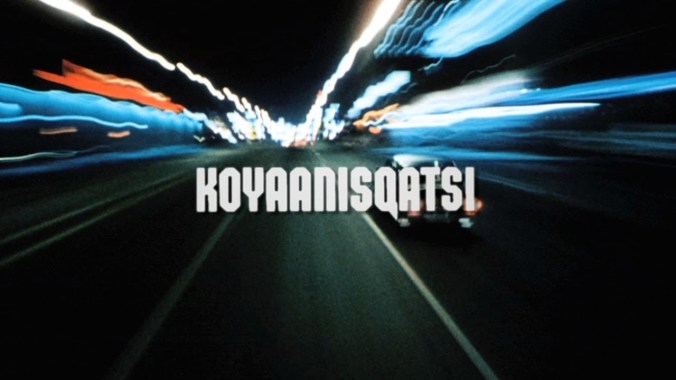
So I discovered that the entire groundbreaking, timeless, brilliant film is free on youtube.
Instructions for those who have not seen Koyaanisqatsi:
1. Stop what you are doing immediately.
2. Turn volume up high.
3. Watch Koyaanisqatsi.
4. Bask in silent astonishment.
5. Thank me.
Honestly, this is one of those life-changing works of art which you will simply and honestly never forget. I fondly recall my first viewing, laying prone in front of a laptop in a cabin on a mountain at night and feeling my astonishment overtaking all physical sensation. This truly begs for the big screen, or at least a reasonably large one, with a reasonable sound system accompanying the visuals. Yet its artistry thrives in any time, place, or size. Which is exactly why I am sharing the profound discovery that it is free to anyone willing to pay only time and curiosity. Hell, if you have firefox with adblock plus, you won’t even see the ads (and honestly, get it – I couldn’t imagine this seamless dream interrupted by commercials) and the only thing you’re missing is the absolute clarity of the original high fidelity print. You’ll undoubtedly recognize certain elements within this time travelling all-encompassing slice of Life Itself, both stylistically and culturally. From the frenzied time-lapse shots of nature and city life contrasting with assembly lines and traffic patterns to the impossibly slow motion glimpses of astonishment and banality, the style and content of this film has influenced more than a generation of visual art and storytelling.
The best part is that I haven’t even gotten to the music; the reason this stands 30 years on as the timeless accomplishment it is: Philip Glass‘ score is the 10 ton monolith blocking out the sun, the elephant in the room, the absolute gravitational pull of this work. If you are at all familiar with 20th century minimalism via Charlemagne Palestine, Steve Reich, Terry Riley or their contemporaries, or especially Glass’ emotive, often romantic take on the sound, you are likely already familiar with some or all of these sounds; if not you are in for a warm embrace of what will likely become a hermetic world you’ll find easily inhabited and unequivocally addicting. Call it lazy, but having the film here and ready to watch makes me reluctant to begin ascribing descriptors to the music. It must be experienced to be grasped. The marriage of sound and picture is essential for direct, uninhibited understanding, for knowing the intrinsic appeal of minimalism itself, for laying bare the nature of conceptual ourboros, the cyclical existence we’re evolved to respond to. This score is meant to evoke the cosmic design of life itself from violent beginning to violent end and all of the impossibly close and personal yet gigantic moments in between.
Note: Do not listen before viewing. Although entirely gorgeous, worthy, and entrancing on its own… divorced from the imagery at birth, Glass’ score will never reach the same affection and thus should be saved for after-film experience.



 Optimistic Underground