Steve Reich’s Early Works

Early Works is a collection of various mould-breaking recordings Steve Reich produced before truly igniting his star with the trademark instrumental minimalism he continues to perfect today.  They are as essential to current minimalism as blues itself was to the invention of rock ‘n’ roll.

earlyworks

Groundbreaking in every sense of the word.  Half of the record consists of musique concrete-style tape loop experiments: Come Out and It’s Gonna Rain – respectively based on vocal samples about police brutality and apocalyptic evangalicalism.  On Come Out, words are presented at first unvarnished, sounding straight from a tape recorder.  “I had to, like open the bruise up, and let some of the bruise blood come out to show them-” states a youthful voice, halting and immediate.  A few repetitions in it begins to split, speeding up in one channel and slowing to an uneasy cadence in the other.  Eventually the dissonance created between the two is combined into a single raucious, nearly beat-driven refrain of “come out / to show them” as two sides of an aural samurai sword swinging to obliterate the mind’s preconceptions of the human voice.  Deconstructing so fully through looping, splicing, and speed, the listener forced to confront the individual phenotypes of speech itself, the malleable nature of words and voice.  A backing beat appear to solidify, but it’s only a byproduct of this snippet of dialogue sifting its way toward a nearly sublime (though always unnerving) rhythm.  The second, It’s Gonna Rain, starts off with prophetic booming preacher assertions, including the titular phrase, which devolves through the same techniques into a cacophany of beats and noise, before developing in the song’s second half into an absolute maelstrom of unrecognizable shouting in tongues.  Except the tongue-speak is fed through a kaleidoscopic blender where only the faintest remnants of whole syllables are detectable.  It’s a disorienting, slightly terrifying, ultimately satisfying journey into the unknown.

The other half of the record hews much closer to the later phase driven work Reich is most known for.  Piano Phase, written just one year after the tape works, showed his genius for the sublime instrumental passages in full bloom and ready for the major leagues.  It’s a piece still played by ensembles when performing selections from his vast body of work, and for good reason.  The same ecstasy-wracked trance effects evident in this 20 minute blissout echo today throughout everything subsequently written by the man.  Simply put, there would be no Music for 18 Musicians, Drumming, Octet, Different Trains/Electric Counterpoint or City Life without this definitive, seed planting piece.  The juggernaut is followed by a short song aptly titled Clapping Music.  If you’ve followed along at all by this point, what’s in store should be obvious.  It’s fantastic.

[for years these recordings were a rarity spread across dozens of disparate and out-of-print vinyl releases, but can be handily obtained via boomkat, cduniverse, or the dependable portal of amazon]

Yo La Tengo – The Sounds of the Sounds of Science

Yo La Tengo - Sounds of the Sounds of Science

Yo La Tengo are one of the most consistently brilliant and longest-running bands in existence today, rivaled only perhaps by Sonic Youth in the longevity-with-strong-artistic-integrity department. They’ve crafted everything from ferocious punk blasts to elegiac orchestral epics, infusing every sound with their signature heartfelt energy.

Continue reading

Steve Reich – Drumming

Steve Reich may be most well known for his groundbreaking juggernaut Music For 18 Musicians; it’s truly unfortunate when most listeners don’t reach beyond that obvious landmark.  Written nearly a decade prior, this piece is one of the most unified, thorough explorations of a concept in the renowned composer’s towering oeuvre.

Drumming is an unequivocal masterpiece of singularly blinding focus.  The title and cover art alone convey more about this landmark than any copious wordplay could aspire toward.  It’s equivalent to Reich’s artistic kernel, a core sample taken from the root of his genius.  The ideas contained herein were expanded and mutated into everything composed in the intervening years.  This is the skeleton, the blueprint, the foundation.

Of course, it’s also a hypnotic masterpiece, a fully realized evocation of everything interesting about modern minimalism.  The drum patterns evolve so quickly and naturally that when layers begin dissipating near the final movement in a slow decrescendo of complexity, the feeling is akin to being woken gently out of a deep slumber:  peeling back comfortingly warm layers of blankets until the cool air sparks movement and consciousness.  Emerging upon the final moments, the most immediate, compelling notion is to hit snooze and resume the dream, from the beginning.  Drumming is a state one leaves reluctantly and with hesitation.

Thankfully, we need not wait until twilight to re-experience this particular dream.

[various releases exist, though check amazon for the version I’ve described, or cd universe where it’s a bit cheaper]

The Field – From Here We Go Sublime

Two years ago, The Field (aka Axel Willner) dropped this masterpiece of maximized minimalism from the sky to explode notions of what infectiously catchy dance music can be built from.

The_Field_-_From_Here_We_Go_Sublime

Pure, ecstatic, sustained immediacy.  This album hits your aural pleasure centers with laser precision from the first moment until the final echo wash.  Using clipped, compressed, shifted, exploded and otherwise modified samples to not only transmit a distinctly amorphous energy, but construct the beats – with each set feeling like micro-worlds unto themselves, tiny galaxies streaming by at high speed.  When Willner slows things down, as he does halfway though the aptly-named title track, eureka is the only natural response.

Grabbing throats and forcing attention, each song proceeds to evolve into a hypnosis-inducing pattern.  The best ones come on feeling hardwired into some primal wavelength in the hypothalamus, unrelentingly catchy until the last moment when elements unravel and a synth stab reveals itself as a pitched vocal, organ lines deflate into a rhythm bed.  An entire song tips over, unravels like a suture, and spills out The Four Tops.

Residing naturally at Kompakt,  his sound is pitched somewhere between the progressive ambient techno of The Orb and the ‘pop ambient’ of label founder Gas (Wolfgang Voigt); of course, to fully visualize you’ll have to imagine Willner floating in some sort of dirigible far above the proceedings.  Not to say that this is objectively better than either of those artists, of course – The Field simply aspires to loftier atmospheres than his forebears.

To put things laconically:  this is four on the floor dance music with enough inner life and microscopic detail to satisfy the deepest of psych connoisseurs, infused with the energy to keep a party stomping though it’s hourlong runtime, and entrancing to the point of total willing surrender.  So let go.  Put on those headphones.  Succumb to the kinetic charms.  From here we go sublime, indeed.

[check this grand record out at boomkat or, of course, amazon]

Steve Reich – Music For 18 Musicians

Steve Reich is possibly my favorite living composer.  His strain of mimimalism has coursed its way through several branches of the tree of modern music.  These ideas have proved to be the backbone for a plethora of genres and soundscapes we enjoy today.

steve_reich

His music feels like the core of something – the central axis of entire galaxies of sound.  Anyone hoping for a solid grounding in modern music needs to get closer.  Reich is scriptural-level essential.  His tones are so identifiable that once you’re familiar, you’ll start to notice the signature embedded in everything.

I’m hoping to avoid giving the impression that listening to Reich is akin to homework, so here’s the real score:

This is some of the trippiest, most hypnotic, enveloping and overwhelming music I’ve laid ears on. The style may be minimalism, but it only feels that way if your volume is turned improperly low.

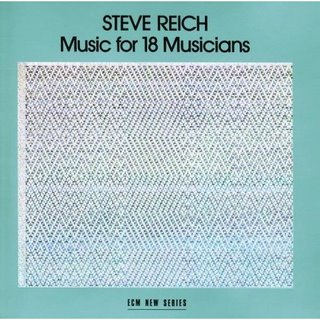
Here is a first taste of Reich: The original Music For 18 Musicians on ECM records.

reich18musicians

While not necessarily the man’s best composition, Music For 18 Musicians is a wonderful introduction to the unique harmonic building blocks with which Reich constructs his work.  Warm oscillations breed an inviting serenity in the first moments, and the listener is quickly whisked down a gently cascading river of sublimity.  Based around an ABCDCBA structure, each section melodically deconstructs a given chord and rebuilds it;  every bit is cyclical, and the whole piece winds into itself at the end.  Perfect symmetry.  It sounds simple, and it is.  Nothing has ever been so divine.

[grab this original ECM recording from amazon – there are several other recordings of this work which I will be covering in the future]

Liquid Liquid

This band is the funkiest bunch of white guys to emerge from the fertile early-1980’s NYC no wave scene. Featuring one of the most well-known bass lines in recent history, Liquid Liquid are nonetheless relatively unknown to the wider public.

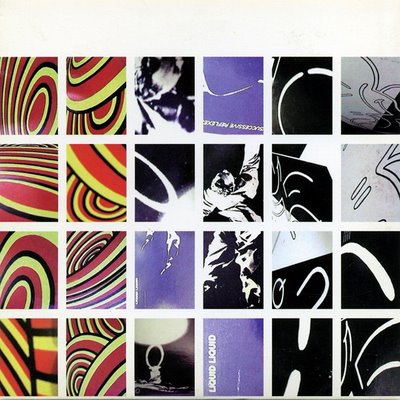
Liquid Liquid is a self-titled collection of everything essential.

liquidliquidcover

To wit: if this band were James Brown, Cavern would be their Funky Drummer.  The moment that transcendent rhythm comes to life on the track, you’ll be awash in familiarity and confusion in the same instant.  Is this White Lines (Don’t Do It) by Grandmaster FlashPhenomenon by LL Cool J?  Both.

Despite that track’s endearing, enduring charm, it’s not even the best thing here.  This collection is overstuffed with quality material, ranging from party-ready bangers to truly outré beat and noise explorations.  None of it comes within spitting distance of mainstream pop or modern club music, by any stretch of imagination.  One listen though and you’ll be convinced that the ideas contained are the base root for a wide breadth of modern music, popular and obscure alike.

This LP is actually a set released in 1997 by Grand Royal containing basically everything you could want to hear from the band’s limited output.  First track Optimo will blow you away.  Cavern is next.  You’re now on a dark, funky rollercoaster to the end.

[grab this amazingly fresh and complete set at amazon]

bonus:  Cavern video!

Boris – Flood

Boris Flood

Boris. Often mistakenly considered simply a doom/stoner/sludge outfit, the Japanese band has managed to subtly weave in varying textures throughout their discography. On this particular record, they keep things on a minimal page and emerge with their most powerful, transformative work in the process.

Continue reading