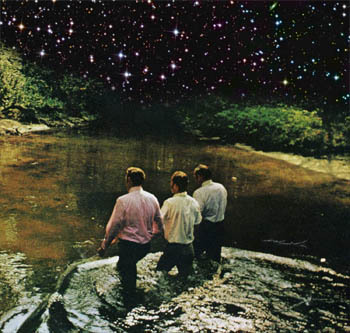
Oneohtrix Point Never – Scenes With Curved Objects

Scenes With Curved Objects has become (possibly) my 2nd favorite release by Oneohtrix Point Never.
Well, this brief cassette release is at least tied with the two LPs preceeding the possibly-album-of-the-year Returnal.  Yes, like those psychotropic soundscapes, it is indescribably gorgeous.  Pulsing with an alien life unique in Oneohtrix Point Never‘s oeuvre, these two live-sourced tracks foreshadow the drifting-cloud majesty of Returnal while rumbling with the some of the most concrete rhythms he (Daniel Lopatin) has yet recorded.

It begins with what sound like marimbas via a familiar-enough repeated melody, simply growing in intensity – never changing – throughout the 9 minutes of Melancholy Descriptions of Simple 3D Environments.  The draw here is how Lopatin slowly cocoons this spine, draping layer upon layer of undulating synth washes, echoed laser effects, and eventually the swelling heart of warming drone takes everything right off the ground.  Side B opens with what can only be described as The Caretaker (aka Leyland Kirby) riffing on something more triumphant than haunting:  a hollowed out and dispatched-from-the-past orchestral section valiantly tries to break through the corrosion.  Then we abruptly cut to a short murky collage which feels like bumping through a science lab in the dark before drifting directly into the triumphant heart of this piece: The Trouble With Being Born.  An oscillating fuge of an (uncharacteristically) optimistic dystopian anthem, this largest cut of the side’s 9 minutes feels like the true contemplative center of the release, a space where all conscious thought lifts up and outward.  In other words, it’s 5 minutes that will totally “expand your mind,” man.  Then a proverbial sudden-record-scratch moment happens and we cut to an Ariel Pink damaged-AM-pop sound refracted in the same manner as the previous collage, fading toward silence.

It’s quite a ride.  Short but intense.  Listen.

Tracklisting:
A Melancholy Descriptions of Simple 3D Environments
B Adagio In G Minor Screw/Piano Craft Guild Edit/The Trouble With Being Born/Let It Go

[get the mp3 edition at boomkat or try and pick up the tape via discogs..but good luck with a fair price.]

[see also on Optimistic Underground: Antony and Fennesz on Returnal 7″ and Oneohtrix Point Never and Days of Thunder]

Brock Van Wey – White Clouds Drift On And On

Brock Van Wey took a headfirst leap off the end point of dub techno last year into the oceanic swells of ambient bliss on this first album under his given name.  Instead of crashing into the waves and sinking, the man usually known as Bvdub simply took flight and never looked down.  This is White Clouds Drift On And On.

Continue reading

Skyramps – Days of Thunder

Skyramps is the combined efforts of Daniel Lopatin (Oneohtrix Point Never – loved here recently) and Mark McGuire (Emeralds), spinning electric gold through a tight 33 minute set. If you’re picturing the homespun sci-fi synthesizer burblings of the former soaking in the ethereal guitar ambience of the latter project, you’re on the right path. This is basically mana from heaven for those of us who happen to be fans of both.

Click the artwork to download the album as a zip file.

When I heard about this release, I practically shat myself. 2009 saw the rise of a more user-friendly, nearly pop natured breed of drone music the likes of which had never yet crossed radars. Drone for the masses?  Not quite. But this is, for instance, far more palatable to your radio listener friends than a Final or Scorn, or even latter day Seefeel album. There’s more dynamic movement than the Gas discography and an airy, inviting tone accompanying the head-nodding foundation. Intertwining lush guitar melodies with Lopatin’s signature synth histrionics, the album soars and soothes in all the right places. The first two tracks feel almost like personal intros for the artists, opening with the prominent sounds of one and slowly adding a dose or two of the other until a fine balance arrives at the end. The second half of the album is where the alchemy truly shines with a blend unique to this recording, and is the gut-level satiating reward for those venturing into this eerie place.

The two obviously know their audience and the images these sounds tend to conjure: warm memories of genre films on tattered VHS (or better- Betamax!) tapes, doodling pictures of Spinners and Darkness, and the unshakable knowledge that anything electronic and/or spacey was the definitive way of the future. These four tracks evoke the optimistic pulse of accelerating full-bore into a strange land of colored light and skyscraping wonder. Maybe it’s not utopia but it’s different than here.  More interesting. Lopatin and McGuire also seem to be acutely aware of how this earnestly nostalgic sensibility lends itself to parody and have pre-empted the inevitable jokes with a wonderfully tongue in cheek title:  Days of Thunder. There aren’t many more emphatically day-glo versions of 1980s Western hubris than the eponymous Nascar thriller and another certain flick by director Tony Scott. Thankfully the album’s palette hews closer to brother Ridley‘s then-unparalleled visions of alternate realities.


blade-runner

Folks of a certain age, eat this up. You’ll be digging through dusty childhood crates and pre-ordering tickets for that new Tron movie in no time.

[although printed in a limited run of 75 cdr copies, there are a couple available via discogs for reasonable price, and of course, *elsewhere* in digital form]

*And seriously, watch that Tron trailer. It looks quite a bit more than alright!

Oneohtrix Point Never

‘It will astound you.’

The Korgis may not have been prophesizing the likes of Daniel Lopatin, aka Oneohtrix Point Never, but that doesn’t stop me from employing the lyric in prelude to this fantastic adventure.  So come on.  Open up.  Change your heart.

When a tonic this refreshing comes along under strange and rare circumstances, the first impulse is to bottle it up and zealously guard what we can, keeping the secret inside – lest the surprise and wonder be spoiled once the wider world is clued in.  The exuberant thrill of something so foreign and new, mainlining into that place where awestruck dreams and hazy childhood memories  intersect, is a thing to behold.  After burrowing deep into the material and subsisting on the sound alone, though, we emerge with the burning desire to shout about this revelation from the nearest hill top.  We want to place it in the hands of our friends and loved ones, imploring them to give it a try.  We get on the internet and write a blog post about it.

But first, we live in the belly of this beast for a while.  The world inside is warm, coated in a futuristic glaze and resting on a plate of brittle nostalgia.  The illusion of inhabiting my greatest preadolescent sci-fi fantasies threatens to crack at any moment, but the dream sustains over any running time.  The most inviting synthesizer tones on the planet mix with an untethered, noisy veneer to coat the entire sonic range from genteel new age to corrosive heavy drone, spiked with the best and brightest futuristic love letters the past has had to offer.  From Vangelis‘ darkly soaring Blade Runner score to the paranoid stabs of The Terminator, Terry Riley‘s groundbreaking dreamscape A Rainbow In Curved Air to the stark electronic shores of Manuel Göttsching (Ash Ra Tempel), this territory is clearly the province of an indelibly spacey imagination.

Zones Without People, my personal introduction to the artist, is the most obvious place to look now.  In a league populated by a select few contemporary dreamers and astral drifters like Emeralds and White Rainbow (see New Clouds and Best of 2009), Lopatin grasps the sonic galaxy whole cloth and spirits it away to his lab where every star, planet, and asteroid belt is shot through and wrung out with the latest in mind-bending laser technology.  Like the lush oxygen garden aboard the Icarus on its journey to reignite the sun, the entire work is suffused with the gritty footprint of organic life – bird calls, frogs, bubbling rivers, wind and all manner of insects echo from the depths – and organized into a most efficient delivery system for aural dopamine.  Channeling the aforementioned musical gods and hinting at further realms yet unexplored, the half hour recording transcends and transports far beyond its modest borders.  This is a monumental trip, in every sense of the word.

Next we have A Pact Between Strangers, a beguiling triptych of the most effervescent, liquid shapes Lopatin has worked with.  Sandwiched between two 12 minute throbbing drone epics, the title track strikes a soft nerve between the yawning pulse of Gas, the hard lines of straight Detroit techno, and the subtly sampledelic nature of Zones Without People‘s most tactile passages.  Beginning as a relaxed sequel to the opener, When I Get Back From New York floats from the most gently narcotic river bed upwards to find a maelstrom on the surface, a dervish of synth rapids and hissing meteor showers.  As the piece winds to a close and the solar winds exhale, total surrender has been achieved.  This is music to offer oneself up to completely.  Embrace it, climb inside.  Once acclimated, the journey outward is harsh.  The dials here are always pegged at elation, so it’s best not to make a move in that direction.

[with the originals impossibly hard to come by on their limited vinyl and CD-R releases, the majority of OPN’s output has been remastered and packaged into the 2cd Rifts compilation, available at boomkat, amazon, or directly through the man himself at pointnever.com]

Music For Our Future

So apparently to help promote the prequel series to Battlestar Galactica, Syfy channel has worked with Pitchfork and XLR8R to curate a far-better-than-it-has-any-right-to-be compilation “inspired” by the new show, Caprica.  Rather than toss together a random selection of indie pop hits aimed at moving units, those responsible have created an ostensibly futuristic sounding mixture of left-field beat excursions, austere psychedelia, and blissed out ambience – and released Music For Our Future completely FREE of charge.

That’s right, this sublime collection is just a click away.  The best part is that the selection is of such uniformly high quality, containing several tracks unavailable elsewhere, that it would easily warrant a purchase price if they so chose.  Thankfully, their commercial impetus for appearing generous is a freewheeling invitation for those of us more into music than television to indulge in something we don’t get every day: an official mixtape that’s not only surprisingly eclectic and deep, but coherent and fluid unlike all but the best of film soundtracks.

Basically comprised of several key satellites orbiting the modern avant electronic landscape with a foot or two firmly in more well known indie territory, this playlist promises to release listeners from the shackles of gravity and set them adrift somewhere outside the oort cloud without a tether in sight.  Sliding through warm drones, cold glitch, crushing dub, rapid space grooves and minimal-everything, we’re right on the cusp of anything conceivably fitting for this particular title.

The tracklisting:

1. Lusine – Gravity

2. Atlas Sound – Walkabout

3. Hudson Mohawke – FUSE

4. White Rainbow – Raw Shanks a Million

5. King Midas Sound – Outta Space (Slow Version)

6. Low Limit – Turf Day

7. Willits and Sakamoto – Toward Water

8. The Field – I Have the Moon, You Have the Internet (Gold Panda Remix)

9. Tyondai Braxton – Uffe’s Woodshop

10. Untold – Luna

11. Nice Nice – See Waves

12. Richard Devine – Matvec Interior (feat. Otto Von Schirach)

13. Peter Kirn – Anaxagoras

[once again, this is completely FREE.  so grab it and enjoy]

White Rainbow – New Clouds

White Rainbow (née Adam Forkner) recently tore through the autumn skies to drop this bomb, blowing away expectations, surpassing anything I could have anticipated after the already-excellent 2007 LP Prism of Eternal Now.  Expanding on the warm, nebulous nature of his live jam constructions, New Clouds is an impossibly appropriate title for one of this year’s best records.

white-rainbow

Transcendent, overwhelming, hypnotic bliss.  Building layer upon layer of drones, stretched and echoed vocals, muted tribal percussion, and gorgeous synth swells, each track is a towering confection allowed room to naturally develop and breathe.  The four tracks comprise an hourlong running time, every moment feeling palpably open and inviting.  This album inspires and propels further listening, rather than demanding it.  Songs begin focused on a singular element, be it delayed acoustic guitar strums or rubbery hand drumming, and evolve with such grace and intuitive logic that final assembly is nearly imperceptible.  This music simply happens, while the conscious mind is busy absorbing the amorphous beauty like a pillow swallowing a blissful dreamer.  Informed by a wide range of greats, from Terry Riley to Can at their most euphoric, Forkner has finally broken through to a plane where his art exists on its own terms, immaterial of time or place.  This album raises hypnagogic exploration to new heights.

[pick this brand new album up at boomkat or amazon, or directly from kranky, a label fully deserving of your support]

John Cale & Terry Riley – Church of Anthrax

John Cale & Terry Riley, two of the most important names in 20th century composition, formed an unlikely alliance for this one-off project in 1971. The result was one of the weirdest entries in either sonic titan’s personal oeuvre.

cale-riley-church

First of all: look at that cover art! After dozens of listens, I still don’t know the significance of this, yet have grown more fond each time I see it. The care and attention put into this is a small signifier of the music within; the big picture may seem obviously grand on first glance, yet astounding little details emerge during close inspection and bring the project into focus when one returns to the wider view.

Instead of performing a balancing act between Riley’s spacey minimalism and Cale’s avant-rock nature, each artist seems to pull the other in a direction previously unexplored. Of course, it’s not entirely surprising if you’re familiar with the output of both geniuses, but the sound is defiantly no exact split down the center of their respective sensibilities. From raging textural passages to alien placidity, through jazz whispers and on to a straight up vocal number, there’s more variety in these five tracks than a good portion of the rest of their careers.

The opening features Riley-an organ tones riffing over a krautrock groove of moaning guitars and intricately barbaric drumming, the whole jam subtly erupting and then sighing to a close. Second track The Hall of Mirrors in the Palace at Versailles hews closest to Riley’s minimalist nature with an appropriately meandering, lost-organ and woodwind shuffle while the short closer, The Protege, feels almost like a lost bluesy instrumental from The Velvet Underground‘s golden days (when Cale was in the group). Everything in between veers wildly between these extremes and even, in the epic centerpiece Ides of March, shoots for the moon in a song so neurotically busy with busted drums and ticklish piano that it manages to evoke one of my favorite turns of phrase: maximized minimalism.

The project seems to have been such an exception for each artist that, by all accounts, neither was satisfied with the end result. Luckily for those of us with an outside view, the work stands on its own as a unique hybrid, a historical artifact, and an eclectically bopping good listen.

You can unearth this brilliant jewel of a buried treasure at cduniverse or amazon.