Miguel Atwood-Ferguson Ensemble – Drips/Take Notice

I had nearly forgotten:  this is one of my favorite things ever.

Or at least the past year.

In late 2010 this clip from a July 23 concert in Los Angeles was posted and I realized how much of an incredible force of nature Miguel Atwood-Ferguson is.  Flying Lotus fans know him as the guy providing the string arrangements in the legendary album Cosmogramma, while those more familiar with J Dilla probably smile at the thought of his work as headliner of the Timeless: Suite For Ma Dukes album, a sweeping orchestral take on the late James Yancey’s productions.  This 13 minute alchemic beast weaves a stargazing intro from the former into one of the sparkling highlights of the latter’s final statement, the Ruff Draft EP, into an uplifting, hard charging masterpiece.

Truly an all star production, this band includes none other than Flying Lotus himself, Thundercat (best known for 2011’s Golden Age of the Apocalypse and making Cosmogramma jump like frogs in a dynamite pond), Rebekah Raff (another Flylo alum, she of the Alice Coltrane-worthy harp ethereality) and a full set of accomplished musicians I’ll list below.

Flying Lotus (laptop)
Miguel Atwood-Ferguson (violin)
Evan Francis (flute)
Dontae Winslow (trumpet)
Joey Dosik (alto sax)
Kamasi Washington (tenor sax)
Garrett Smith (trombone)
Rebekah Raff (harp)
Marcel Camargo (guitar)
Brandon Coleman (keys)
Stephen ‘Thundercat’ Bruner (bass)
Chris ‘Daddy’ Dave (drums)
Nikki Campbell (percussion)

I’m just hoping this hints, if not at Flying Lotus‘ next album (which will be announced at Coachella) perhaps a collaborative effort or even a full length release from this Ensemble itself.
ATTN: unintentional hiatus.

Or: I will not have much opportunity for internet-related anything for the next month, but would love if any of you friendly charitable readers / friends / good samaratins could help keep me up to date on great music still being released in the late hours of this year.

So please, leave a comment here and let me know what you’re into, the triumphs and sure shots and surprise masterpieces I’m missing out on.  I promise to get myself caught up in due time and come roaring back with a vengeance.  This is a time of patience and focus for me, and the words are building up.

For now, I leave you with one of the greatest pieces of music ever recorded: After The Flood, by Talk Talk.

I once said “This song is a sentient being,” and I still stand by that statement.

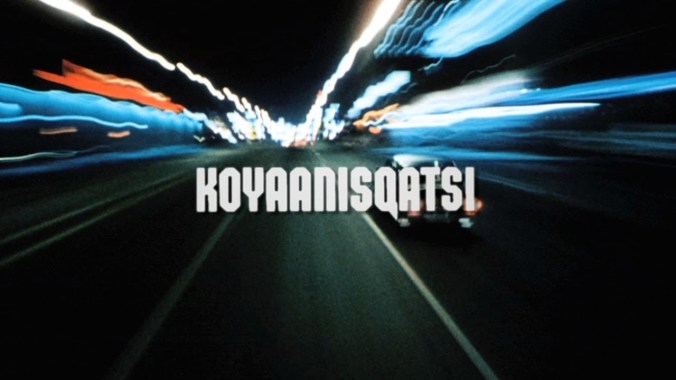
Koyaanisqatsi

So I discovered that the entire groundbreaking, timeless, brilliant film is free on youtube.

Koyaanisqatsi

Instructions for those who have not seen Koyaanisqatsi:

1. Stop what you are doing immediately.

2. Turn volume up high.

3. Watch Koyaanisqatsi.

4. Bask in silent astonishment.

5. Thank me.

Honestly, this is one of those life-changing works of art which you will simply and honestly never forget.  I fondly recall my first viewing, laying prone in front of a laptop in a cabin on a mountain at night and feeling my astonishment overtaking all physical sensation.  This truly begs for the big screen, or at least a reasonably large one, with a reasonable sound system accompanying the visuals.  Yet its artistry thrives in any time, place, or size.  Which is exactly why I am sharing the profound discovery that it is free to anyone willing to pay only time and curiosity.  Hell, if you have firefox with adblock plus, you won’t even see the ads (and honestly, get it – I couldn’t imagine this seamless dream interrupted by commercials) and the only thing you’re missing is the absolute clarity of the original high fidelity print.  You’ll undoubtedly recognize certain elements within this time travelling all-encompassing slice of Life Itself, both stylistically and culturally.  From the frenzied time-lapse shots of nature and city life contrasting with assembly lines and traffic patterns to the impossibly slow motion glimpses of astonishment and banality, the style and content of this film has influenced more than a generation of visual art and storytelling.

The best part is that I haven’t even gotten to the music; the reason this stands 30 years on as the timeless accomplishment it is:  Philip Glass‘ score is the 10 ton monolith blocking out the sun, the elephant in the room, the absolute gravitational pull of this work.  If you are at all familiar with 20th century minimalism via Charlemagne Palestine, Steve Reich, Terry Riley or their contemporaries, or especially Glass’ emotive, often romantic take on the sound, you are likely already familiar with some or all of these sounds; if not you are in for a warm embrace of what will likely become a hermetic world you’ll find easily inhabited and unequivocally addicting.  Call it lazy, but having the film here and ready to watch makes me reluctant to begin ascribing descriptors to the music.  It must be experienced to be grasped.  The marriage of sound and picture is essential for direct, uninhibited understanding, for knowing the intrinsic appeal of minimalism itself, for laying bare the nature of conceptual ourboros, the cyclical existence we’re evolved to respond to.  This score is meant to evoke the cosmic design of life itself from violent beginning to violent end and all of the impossibly close and personal yet gigantic moments in between.

Note: Do not listen before viewing.  Although entirely gorgeous, worthy, and entrancing on its own…  divorced from the imagery at birth, Glass’ score will never reach the same affection and thus should be saved for after-film experience.

John Cale & Terry Riley – Church of Anthrax

John Cale & Terry Riley, two of the most important names in 20th century composition, formed an unlikely alliance for this one-off project in 1971. The result was one of the weirdest entries in either sonic titan’s personal oeuvre.

cale-riley-church

First of all: look at that cover art! After dozens of listens, I still don’t know the significance of this, yet have grown more fond each time I see it. The care and attention put into this is a small signifier of the music within; the big picture may seem obviously grand on first glance, yet astounding little details emerge during close inspection and bring the project into focus when one returns to the wider view.

Instead of performing a balancing act between Riley’s spacey minimalism and Cale’s avant-rock nature, each artist seems to pull the other in a direction previously unexplored. Of course, it’s not entirely surprising if you’re familiar with the output of both geniuses, but the sound is defiantly no exact split down the center of their respective sensibilities. From raging textural passages to alien placidity, through jazz whispers and on to a straight up vocal number, there’s more variety in these five tracks than a good portion of the rest of their careers.

The opening features Riley-an organ tones riffing over a krautrock groove of moaning guitars and intricately barbaric drumming, the whole jam subtly erupting and then sighing to a close. Second track The Hall of Mirrors in the Palace at Versailles hews closest to Riley’s minimalist nature with an appropriately meandering, lost-organ and woodwind shuffle while the short closer, The Protege, feels almost like a lost bluesy instrumental from The Velvet Underground‘s golden days (when Cale was in the group). Everything in between veers wildly between these extremes and even, in the epic centerpiece Ides of March, shoots for the moon in a song so neurotically busy with busted drums and ticklish piano that it manages to evoke one of my favorite turns of phrase: maximized minimalism.

The project seems to have been such an exception for each artist that, by all accounts, neither was satisfied with the end result. Luckily for those of us with an outside view, the work stands on its own as a unique hybrid, a historical artifact, and an eclectically bopping good listen.

https://www.youtube.com/watch?v=sOfE3cvGv3M

You can unearth this brilliant jewel of a buried treasure at cduniverse or amazon.

Steve Reich’s Early Works

Early Works is a collection of various mould-breaking recordings Steve Reich produced before truly igniting his star with the trademark instrumental minimalism he continues to perfect today.  They are as essential to current minimalism as blues itself was to the invention of rock ‘n’ roll.

earlyworks

Groundbreaking in every sense of the word.  Half of the record consists of musique concrete-style tape loop experiments: Come Out and It’s Gonna Rain – respectively based on vocal samples about police brutality and apocalyptic evangalicalism.  On Come Out, words are presented at first unvarnished, sounding straight from a tape recorder.  “I had to, like open the bruise up, and let some of the bruise blood come out to show them-” states a youthful voice, halting and immediate.  A few repetitions in it begins to split, speeding up in one channel and slowing to an uneasy cadence in the other.  Eventually the dissonance created between the two is combined into a single raucious, nearly beat-driven refrain of “come out / to show them” as two sides of an aural samurai sword swinging to obliterate the mind’s preconceptions of the human voice.  Deconstructing so fully through looping, splicing, and speed, the listener forced to confront the individual phenotypes of speech itself, the malleable nature of words and voice.  A backing beat appear to solidify, but it’s only a byproduct of this snippet of dialogue sifting its way toward a nearly sublime (though always unnerving) rhythm.  The second, It’s Gonna Rain, starts off with prophetic booming preacher assertions, including the titular phrase, which devolves through the same techniques into a cacophany of beats and noise, before developing in the song’s second half into an absolute maelstrom of unrecognizable shouting in tongues.  Except the tongue-speak is fed through a kaleidoscopic blender where only the faintest remnants of whole syllables are detectable.  It’s a disorienting, slightly terrifying, ultimately satisfying journey into the unknown.

The other half of the record hews much closer to the later phase driven work Reich is most known for.  Piano Phase, written just one year after the tape works, showed his genius for the sublime instrumental passages in full bloom and ready for the major leagues.  It’s a piece still played by ensembles when performing selections from his vast body of work, and for good reason.  The same ecstasy-wracked trance effects evident in this 20 minute blissout echo today throughout everything subsequently written by the man.  Simply put, there would be no Music for 18 Musicians, Drumming, Octet, Different Trains/Electric Counterpoint or City Life without this definitive, seed planting piece.  The juggernaut is followed by a short song aptly titled Clapping Music.  If you’ve followed along at all by this point, what’s in store should be obvious.  It’s fantastic.

[for years these recordings were a rarity spread across dozens of disparate and out-of-print vinyl releases, but can be handily obtained via boomkat, cduniverse, or the dependable portal of amazon]

Bombay the Hard Way

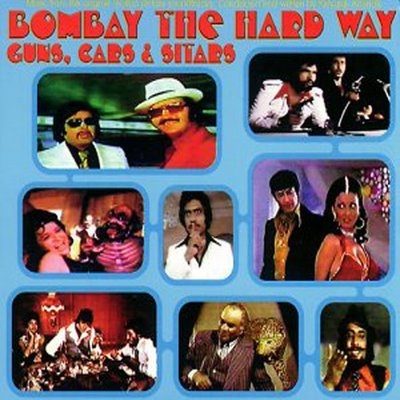
Kalyanji Anandji is the name of an Indian composer duo known for their work on Bollywood film soundtracks, particularly action potboilers in the 1970s.  One glance at the cover artwork for this LP should be enough to give any music or film lover a head start on these sounds.

bombay

In 1998, Dan the Automator collaborated with DJ Shadow to remix, re-title, and reintroduce this action packed eastern funk to a near-clueless western audience.  Floating from jazzy windups to frenzied spy-flick jams, it’s a slick and concise rendering of a very specific intersection of geography and time.  Imagine the best aspects of the greatest hollywood funk scores (Superfly, Coffy, Shaft, etc) reinterpreted by bollywood composers, and processed though a modern hip hop sensibility.  Or just throw this record on and get heads nodding.

[you can grab this used via amazon]

– – – – – – – – – –

[Credit to last.fm for info on Kalyanji & Anandji Shah and especially to beatfanatic for introducing me to this album in the first place.]

Steve Reich – Drumming

Steve Reich may be most well known for his groundbreaking juggernaut Music For 18 Musicians; it’s truly unfortunate when most listeners don’t reach beyond that obvious landmark.  Written nearly a decade prior, this piece is one of the most unified, thorough explorations of a concept in the renowned composer’s towering oeuvre.

Drumming is an unequivocal masterpiece of singularly blinding focus.  The title and cover art alone convey more about this landmark than any copious wordplay could aspire toward.  It’s equivalent to Reich’s artistic kernel, a core sample taken from the root of his genius.  The ideas contained herein were expanded and mutated into everything composed in the intervening years.  This is the skeleton, the blueprint, the foundation.

Of course, it’s also a hypnotic masterpiece, a fully realized evocation of everything interesting about modern minimalism.  The drum patterns evolve so quickly and naturally that when layers begin dissipating near the final movement in a slow decrescendo of complexity, the feeling is akin to being woken gently out of a deep slumber:  peeling back comfortingly warm layers of blankets until the cool air sparks movement and consciousness.  Emerging upon the final moments, the most immediate, compelling notion is to hit snooze and resume the dream, from the beginning.  Drumming is a state one leaves reluctantly and with hesitation.

Thankfully, we need not wait until twilight to re-experience this particular dream.

[various releases exist, though check amazon for the version I’ve described, or cd universe where it’s a bit cheaper]