Fuck Buttons – Tarot Sport

Fuck Buttons released one of the most interesting and polarizing albums of 2008, one of several named on my end of the year list (which would undoubtedly have been published here if Optimistic Underground was running at the time) and a perennial physical overload to unwitting passengers in my car.  This October the English duo are set to blow faces off and disintegrate non-believers with the sonic asteroid they’ve named Tarot Sport.

fuck-buttons-tarot-sport

Using the word epic to describe this music is beyond moot; it’s simply a given at this point.  Yet this fact does little to temper the unshakeable urge to invoke it – and feel it – on every listen.  This is the sort of thing epic was coined for.  Kicking off with the dancefloor earthquake of Surf Solar, expanded to 10 minutes from its early incarnation as a 7″ single, the album shouts its thesis from a mountaintop and gets moving at a breakneck clip.  With an insistent four on the floor beat and stocatto-spliced vocal clips there’s no wonder which of debut Street Horrrsing‘s tracks was the launch point for this sophomore triumph: shining, atmospheric, ass-shaking standout Bright Tomorrow.  Every track, though submerged in the same industrial crunch mana Fuck Buttons are known for, feels more breathable, open, dynamic and most of all catchy, than anything they’ve yet created.  Third track The Lisbon Maru gently (and subtly) conjures the pulsing power-surge key stabs from the debut’s stellar opening (and most popular) track Sweet Love For Planet Earth, swaddling the backbone in vacuumed reverb and what sounds like hundreds of damaged violins compressed into a small wind tunnel and dialing up the velocity throughout its run.

After this point the album transforms into pure, blissed out, pounding noisy nirvana.  Fourth track Olympians blasted its way to the top of my list, where it reigns with impunity, after only my first two listens.  Not content with merely teasing their dancefloor intentions or continuing to shy away from unabashed melody, this striking 10 minute centerpiece showcases everything Fuck Buttons do well and then some.  Finally delivering on the ambitious promise suggested all along, the moment is a revelation: a band fully coming into their own as artists and hitting an undeniably assured stride.  Nothing feels remotely tentative about the syncopated big beat drums beamed through the tonal cloud this song is born in, nor the manner in which every element seems to gather up, tightening into a coiled rhythmic outburst in anticipation of the mythical organ swells beginning three minutes in.  It’s a gorgeous night sky colored with soaring waves of heartrending resonance and shimmering supernovas, exploding out of the mix like galactic pop rocks – a transcendent meteor shower as close and tangible as the ‘play’ button.

Topping that monster would be difficult, if not impossible; the guys instead turn and unleash a funky blast of head clearing noise bop in a (relatively) concise 5 minutes, before diving into sonic rollercoaster Space Mountain (appropriately titled) with driving tribal percussion and twinkling keyboards ablaze.  A nearly-clean guitar tone drives the action, disintegrating in the atmosphere, enveloped in feedback, before giving way to the final push:  closer Flight of the Serpent and its destructive martial stomp.  Swooning UK post rock guitar moves over a clattering speed-march rhythm section, bursting with feedback at just the right moments and sharing the spotlight with a romantic organ pulse grown from Olympians‘ seed.  Feeling almost like a burly reprisal of that apex, the swarm of drone flies suddenly drop away at the halfway point, exposing the skeletal drum pattern and letting it hang, galloping along unadorned for several moments.  Thankfully, majestic crests of oceanic keyboard melody and shattering light beams of narcotic bliss return to guide the album to a satisfactorily dizzying end.

Watch this clip with the volume cranked to whet your appetite if my words haven’t already.

[and make sure to preorder the album at boomkat, norman records (vinyl!), or rough trade – or make your purchase at a local record shop when it drops on October 12]

For my mother.

My mother’s been in the hospital for a few days now.  Nothing catastrophic or life-threatening, thankfully; she’s doing relatively well at the moment but has more procedures and tests coming up and has been stuck in a room on the 4th floor for days.  So I’ve got a little tribute, her self-proclaimed favorite song ever:  The Righteous Brothers‘ eternal You’ve Lost That Lovin’ Feelin’.

I hope you enjoy it as much as I do.  I don’t know if anyone could enjoy it as much as my mother does, though, but try if you’d like!

[regular posting will resume shortly]

John Cale & Terry Riley – Church of Anthrax

John Cale & Terry Riley, two of the most important names in 20th century composition, formed an unlikely alliance for this one-off project in 1971. The result was one of the weirdest entries in either sonic titan’s personal oeuvre.

cale-riley-church

First of all: look at that cover art! After dozens of listens, I still don’t know the significance of this, yet have grown more fond each time I see it. The care and attention put into this is a small signifier of the music within; the big picture may seem obviously grand on first glance, yet astounding little details emerge during close inspection and bring the project into focus when one returns to the wider view.

Instead of performing a balancing act between Riley’s spacey minimalism and Cale’s avant-rock nature, each artist seems to pull the other in a direction previously unexplored. Of course, it’s not entirely surprising if you’re familiar with the output of both geniuses, but the sound is defiantly no exact split down the center of their respective sensibilities. From raging textural passages to alien placidity, through jazz whispers and on to a straight up vocal number, there’s more variety in these five tracks than a good portion of the rest of their careers.

The opening features Riley-an organ tones riffing over a krautrock groove of moaning guitars and intricately barbaric drumming, the whole jam subtly erupting and then sighing to a close. Second track The Hall of Mirrors in the Palace at Versailles hews closest to Riley’s minimalist nature with an appropriately meandering, lost-organ and woodwind shuffle while the short closer, The Protege, feels almost like a lost bluesy instrumental from The Velvet Underground‘s golden days (when Cale was in the group). Everything in between veers wildly between these extremes and even, in the epic centerpiece Ides of March, shoots for the moon in a song so neurotically busy with busted drums and ticklish piano that it manages to evoke one of my favorite turns of phrase: maximized minimalism.

The project seems to have been such an exception for each artist that, by all accounts, neither was satisfied with the end result. Luckily for those of us with an outside view, the work stands on its own as a unique hybrid, a historical artifact, and an eclectically bopping good listen.

You can unearth this brilliant jewel of a buried treasure at cduniverse or amazon.

Tea Leaf Dancers

I just discovered this.  The first track on Flying Lotus‘ breakthrough Reset EP, the video is suitably hypnotic and matches the song’s mood perfectly.  So watch it.  And listen to more of his brilliant work.  I’ll be helping out on that front in an upcoming post…

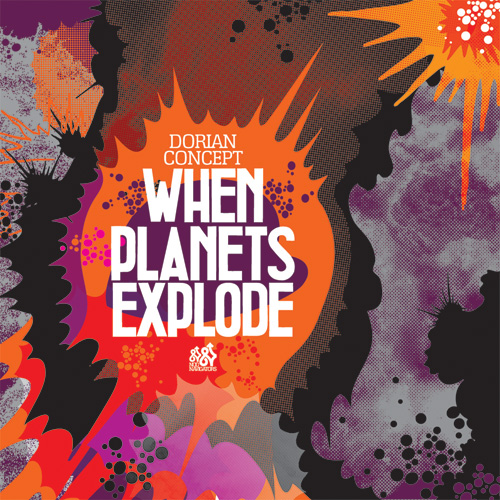
Dorian Concept – When Planets Explode

Dorian Concept is a one-man force of nature from Austria who’s been tweaking beats and spinning trippy jazz tracks for several years – and with the release of When Planets Explode in 2009, finally getting his due and hopefully some worldwide recognition.  Fans of Flying Lotus, Hudson Mohawke, Ras G (whose Brotha From Anotha Planet I’ve gone crazy for), and hell J Dilla himself, are pointedly advised to get in on this action and get familiar with the sick space-jazz-hiphop pulsing out of this LP.

doriancover

This mindblowing mural of textural dexterity and extraterrestrial beat construction bears the hallmarks of Sun Ra or latter-day John Coltrane run through the modern wonky sensibility of beats straight out of a fevered acid dream.  Unrelenting, inventive sounds burst out of the speakers at every turn, keeping the listener on his toes and his neck snapped to attention – no easy head-nodding action here with the sudden tonal shifts and oft-subverted structures.  It’s a highly active album and all the more brilliant for it.  Although not nearly your average party material, the percussion and korg stabs supply ample slam, stuffed into an oceanic low-end that’ll keep any subwoofer busy for the half-hour-plus duration.  This is headphone nirvana, driving at night ecstasy, and fill-the-house explosiveness packed into a tightly wound free jazz banger sure to stupefy anyone willing to indulge in your latest album aquisition.  Grab this and detonate heads along with the solar system.

[snag this brain bender at boomkat for about $7 digital!]

Blue Sky Black Death – Late Night Cinema

Blue Sky Black Death lays down infinitely cinematic left-field instrumental hiphop with their latest album, in the process stretching the very definition of the genre into something altogether more epic and expansive.  This LP widens the scope and practically begs for a dystopian sci-fi film to accompany its stately but tweaked out majesty.  The duo, comprised of Kingston and Young God, threw down this sonic gauntlet at the feet of every other production wizard and studio sculptor last year and have yet to see a contender pick it up.

bsbd-lnc

Of course, using the term ‘cinematic’ for an album with the word practically in its title may seem lazy, until you’ve spun this at a proper volume.  There is no descriptor more apt or quick to pop into mind when listening.  This aspect is nothing new in itself; merely raised to an unheard level and played with finesse and a keen ear for detail that lets the music step forward from a long line of atmospheric beat conductors into it’s own wide screen realm.

To put it in relative (and entirely ignorable) terms, this feels as if Dr. Dre were abducted by extraterrestrials  and dropped off in a state of the art London studio with no memory of his prior life, accompanied only by his prodigious skills behind the boards and cryptic instructions to make a masterpiece with the resources at hand.  All apologies for the seemingly facetious metaphor but if you found yourself nodding at the notion, you’re probably already listening.

Late Night Cinema simply forces a smile at the sheer virtuosity and breadth of vision presented.  No song ends the way it began, each track an internal journey presented with a bravado betraying the confidence these guys have in their ability to lay out a fully fleshed out song sans the crutch of vocals or obvious hooks.  Utilizing everything from live instrumentation to indecipherable samples to what sounds like a full orchestra, they throw everything which works into the mix and  leave no stone unturned in the search for a level of the stratosphere in which to comfortably glide.  Plucked strings, fat horns, crunchy bass, snippets of dialogue, rapping, singing, and found sounds work their way into every crevice of the mix.  The aural environment is packed to the gills and populated with stylistic genius.  Though the nature is sprawling and the landscape expansive, there is simply no wasted space within this record.  Every slavishly worked over millisecond of sound feels buffed to a sheen and ready for the close inspection of a jeweler’s eye.  Honestly, I can’t recommend this enough.

[pick this up via undergroundhiphop or cduniverse, or the always dependable amazon, you won’t regret it]

Steve Reich’s Early Works

Early Works is a collection of various mould-breaking recordings Steve Reich produced before truly igniting his star with the trademark instrumental minimalism he continues to perfect today.  They are as essential to current minimalism as blues itself was to the invention of rock ‘n’ roll.

earlyworks

Groundbreaking in every sense of the word.  Half of the record consists of musique concrete-style tape loop experiments: Come Out and It’s Gonna Rain – respectively based on vocal samples about police brutality and apocalyptic evangalicalism.  On Come Out, words are presented at first unvarnished, sounding straight from a tape recorder.  “I had to, like open the bruise up, and let some of the bruise blood come out to show them-” states a youthful voice, halting and immediate.  A few repetitions in it begins to split, speeding up in one channel and slowing to an uneasy cadence in the other.  Eventually the dissonance created between the two is combined into a single raucious, nearly beat-driven refrain of “come out / to show them” as two sides of an aural samurai sword swinging to obliterate the mind’s preconceptions of the human voice.  Deconstructing so fully through looping, splicing, and speed, the listener forced to confront the individual phenotypes of speech itself, the malleable nature of words and voice.  A backing beat appear to solidify, but it’s only a byproduct of this snippet of dialogue sifting its way toward a nearly sublime (though always unnerving) rhythm.  The second, It’s Gonna Rain, starts off with prophetic booming preacher assertions, including the titular phrase, which devolves through the same techniques into a cacophany of beats and noise, before developing in the song’s second half into an absolute maelstrom of unrecognizable shouting in tongues.  Except the tongue-speak is fed through a kaleidoscopic blender where only the faintest remnants of whole syllables are detectable.  It’s a disorienting, slightly terrifying, ultimately satisfying journey into the unknown.

The other half of the record hews much closer to the later phase driven work Reich is most known for.  Piano Phase, written just one year after the tape works, showed his genius for the sublime instrumental passages in full bloom and ready for the major leagues.  It’s a piece still played by ensembles when performing selections from his vast body of work, and for good reason.  The same ecstasy-wracked trance effects evident in this 20 minute blissout echo today throughout everything subsequently written by the man.  Simply put, there would be no Music for 18 Musicians, Drumming, Octet, Different Trains/Electric Counterpoint or City Life without this definitive, seed planting piece.  The juggernaut is followed by a short song aptly titled Clapping Music.  If you’ve followed along at all by this point, what’s in store should be obvious.  It’s fantastic.

[for years these recordings were a rarity spread across dozens of disparate and out-of-print vinyl releases, but can be handily obtained via boomkat, cduniverse, or the dependable portal of amazon]